By Phillip Tanzilo, CPTD, MHRM
Why understanding the difference can improve learning, collaboration, engagement, and results.
Introduction: Not Every Audience Needs the Same Experience
One of the biggest lessons I’ve learned is that different objectives require different delivery approaches.
Years of client work across leadership development, organizational development, workplace learning, executive facilitation, keynote speaking, and coaching have taught me something important: not every audience needs the same type of delivery. Organizations often group speaking, training, facilitation, coaching, and presentations together because all involve someone standing in front of a room communicating.
The reality is very different. Each delivery style serves as a unique intervention designed to achieve a different outcome.
Throughout my career, opportunities allowed me to deliver each of these engagement styles. Mistakes throughout that same journey also taught me when not to use each one. Those lessons shaped me tremendously.
Public Speaking Creates Inspiration and Alignment: Audiences Leave Energized and Motivated
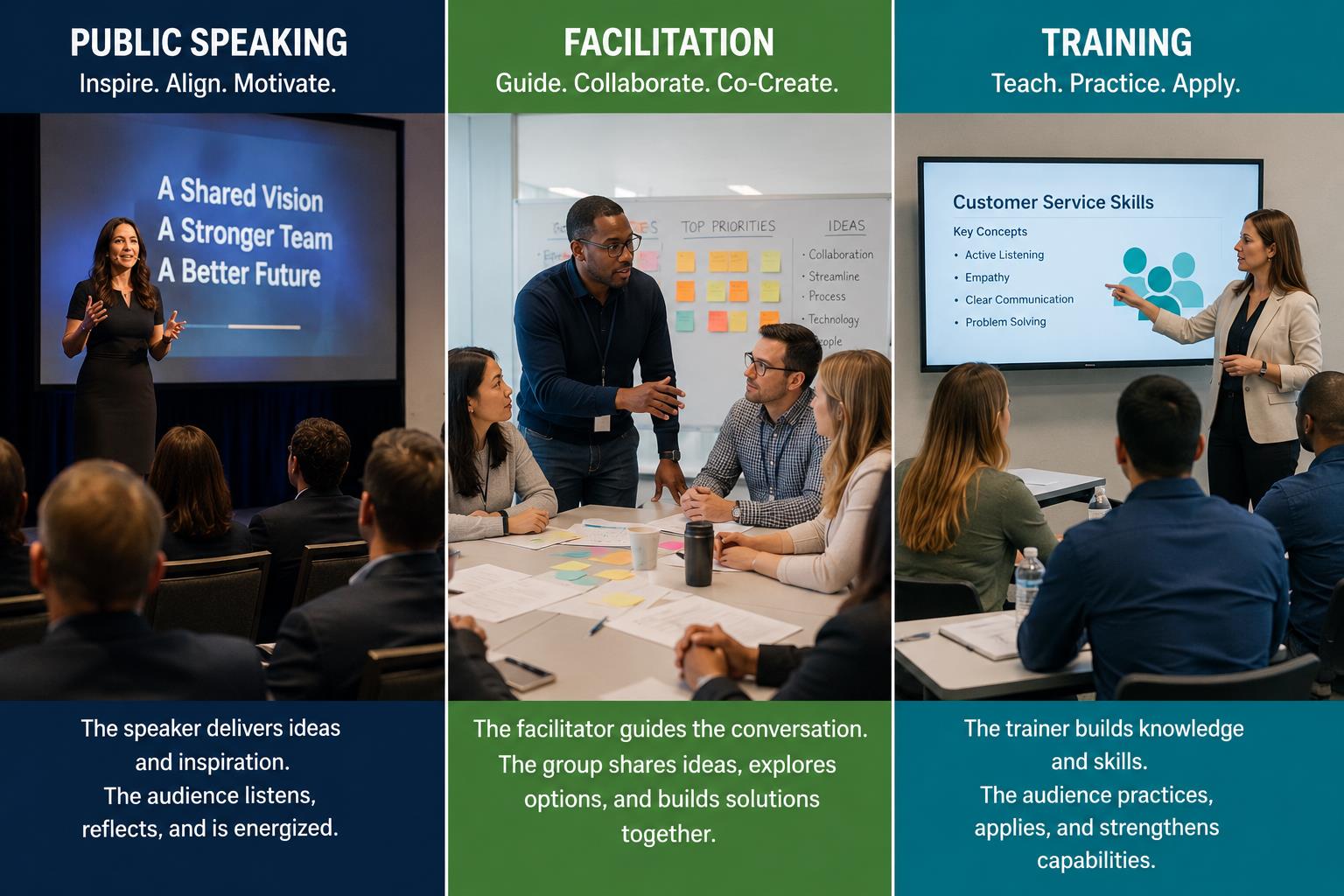
Public speaking works best when the goal is influence, inspiration, and perspective shifting.
I remember a company kickoff where my role was not to teach skills or facilitate decisions. My responsibility was to help employees connect with the vision, build excitement, and create alignment around where the organization was headed.
Public speaking succeeds when the goal involves broad alignment, motivation, emotional connection, or perspective shifting. Audiences listen, reflect, and leave energized.
Public speaking focuses more heavily on inspiration and influence than hands-on application. Storytelling, stage presence, emotional connection, pacing, audience energy, and message clarity become critical skills in these environments.
Facilitation Creates Collaboration and Ownership: Teams Co-Create Solutions Together
Facilitation becomes powerful when the audience needs to think, contribute, and build solutions together.
A strategic retreat I facilitated reinforced another important lesson for me. The objective wasn’t sharing information or teaching new skills. The team needed alignment, stronger decision-making, and collective problem solving. In that situation, facilitation became the appropriate approach because collaboration, dialogue, and shared ownership were essential to achieving the desired outcome.
Participants do not simply listen during facilitation sessions. They co-create. Questioning skills, adaptability, listening, emotional intelligence, process management, and group dynamics become more important than presentation delivery alone.
The facilitator’s role is not to provide all the answers. The facilitator’s role is to help the group discover them.
Training Builds Capability and Behavior Change: Learning Requires Practice and Application
Training succeeds when people can practice, apply, and reinforce new skills.
One customer experience initiative I supported had a very specific objective: improving performance by developing new capabilities. In that situation, training was the appropriate solution because employees needed to build knowledge, strengthen skills, and adopt new behaviors that would improve the customer experience.
Adults learn through interaction, reflection, discussion, practice, feedback, and application rather than passive listening alone. Instructional design, adult learning theory, neuroscience, reinforcement, coaching, and engagement become critical elements of workplace learning.
I have learned that even the most engaging speaker can miss the mark when an audience actually needs skill development. Likewise, strong facilitators can unintentionally spend too much time discussing ideas when participants need structured practice and reinforcement.
Choosing the right approach matters.
Understanding the Difference: Matching the Method to the Outcome
The most effective communicators know when to inspire, when to facilitate, and when to teach.
One of the lessons that has stayed with me over the years is that success is rarely determined by how engaging a speaker, trainer, or facilitator is. Success is determined by whether the approach matched the need. I’ve seen talented speakers placed into training environments, trainers asked to facilitate strategic conversations, and facilitators expected to inspire large audiences. Sometimes it works, but often it creates frustration because the intervention does not match the objective. The most effective communicators begin with the outcome they are trying to achieve and then choose the method that best supports it.
Reinforcement Determines Long-Term Impact: What Happens After Matters Most
I’ve learned that impact is not measured by what happens during the session but by what happens afterward.
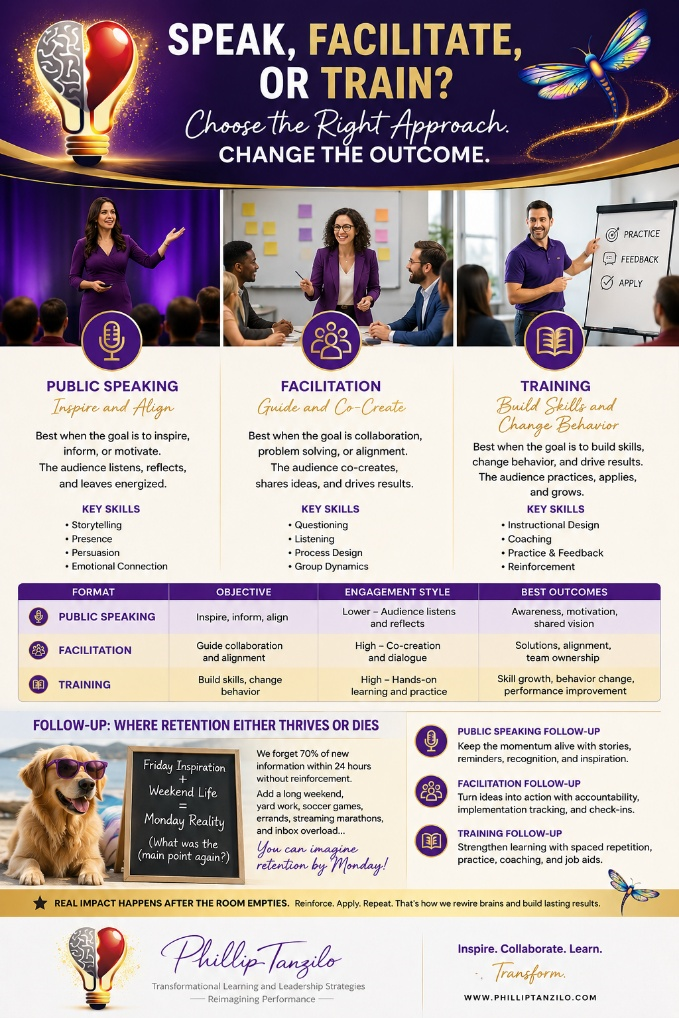
One of the concepts I often share comes from Hermann Ebbinghaus and the Forgetting Curve. Without reinforcement, people forget much of what they learn surprisingly quickly.
Deliver a motivational message late Friday afternoon, add a long weekend, sprinkle in yard work, youth sports, errands, streaming marathons, and overflowing inboxes, and retention can look very different by Monday morning.
Brains are busy places. Different engagement styles require different reinforcement strategies because each serves a different purpose.
- Public speaking follow-up helps sustain emotional momentum.
- Facilitation follow-up helps convert conversations into action.
- Training follow-up strengthens neuroplasticity, retention, and behavior change through practice, coaching, repetition, and application.
Real learning rarely happens because someone attended a single workshop and nodded enthusiastically for two hours.
Final Thoughts: Great Communicators Know Which Tool to Use
The best delivery approach is the one that aligns with the outcome you are trying to achieve.
Trust from an audience is something I take very seriously. Participants invest their time, energy, attention, and expectations into every experience. Leaders trust us with their teams, culture, learning outcomes, and organizational objectives.
My experiences tell me that success is not determined by how well we present. Success is determined by whether the audience receives what they truly need.
- Sometimes they need inspiration.
- Sometimes they need collaboration.
- Sometimes they need skill development.
The key is knowing the difference.
Choosing the Right Delivery Approach: Matching Methods to Outcomes
| Delivery Approach | Primary Objective | Critical Skills | Audience Experience |
| Public Speaking | Inspire, inform, align | Storytelling, presence, persuasion | Listen, reflect, connect |
| Facilitation | Guide collaboration and alignment | Questioning, listening, process design | Discuss, contribute, co-create |
| Training | Build skills and change behavior | Instructional design, coaching, reinforcement | Practice, apply, develop |
TABLE 1. Matching Delivery Methods to Outcomes: Different goals require different approaches. P Tanzilo 2026
Key Takeaways
• Different objectives require different delivery
• Engagement style shapes audience retention
• Training requires instructional design expertise
• Facilitation drives collaboration and ownership
• Reinforcement sustains long-term learning impact
#PublicSpeaking #ExecutiveFacilitation #CorporateTraining #AdultLearning #InstructionalDesign #LeadershipDevelopment #LearningAndDevelopment #AudienceEngagement #NeuroscienceOfLearning #TrainingAndDevelopment #EmployeeDevelopment #LeadershipTraining #OrganizationalDevelopment #ExecutiveCoaching #WorkplaceLearning #PresentationSkills #LearningScience #FacilitationSkills #ProfessionalSpeaking #ChangeManagement #EmployeeEngagement #LearningExperienceDesign #BehaviorChange #SpacedRepetition #Neuroplasticity